
Morris County Release Date Meanings
New Jersey does not use one universal field named “projected release date.” NJDOC defines three dates that answer different questions. The Current Max Release Date is the most recent calculated date for the maximum term after earned days and days added for negative conduct. The Current Parole Eligibility Date is the latest expected eligibility date calculated under State Parole Board policy. The Date Out-of-Custody is historical. It marks the completed release from custody for an incarceration period.
Those labels should not be blended. Eligibility means a person can be considered under the governing rules. It does not mean parole was granted. A grant can set a future date, but release may still be rescinded or delayed. A max date projects the end of the custodial maximum after current calculations. Date Out-of-Custody is the stronger proof that the physical event occurred.
A Morris County jail detainee may have none of the NJDOC fields. County pretrial release depends on a court order and processing. A short county sentence may instead be documented in the judgment and the Morris release record. NJDOC covers the state system, not each brief stay at the Morris County Correctional Facility.
Find Morris County Projected Release Dates
Classify custody first. Morris Facility Records is the operational source for a person physically held at the county jail. NJDOC is the public source for a state prisoner. The court docket explains the sentence or release order. Federal and immigration systems are separate, so a date from one system cannot safely be carried into another.
- Identify the holding system. Use the booking number for Morris County, SBI number for NJDOC, or the correct federal identifier.
- For a state prisoner, open the NJDOC Offender Search, accept its conditions, and prefer an SBI-number search.
- Resolve same-name records with age, aliases, County of Commitment, sentence-as name, offense, and case details.
- Open Current Prison Sentence History. Read Current Max Release Date, Current Parole Eligibility Date, maximum term, mandatory minimum, and sentence date together.
- For a county detainee, call Morris County Correctional Facility Records at 973-631-5174 and check the court case for a release order or sentence.
- After the event, confirm NJDOC Date Out-of-Custody or request the Morris date and time out. Do not treat a no-result as a release.
County of Commitment identifies the place where a state prisoner was tried, convicted, and sentenced. A Morris value does not mean the person remained in the Morris jail. Likewise, a person can be in an NJDOC Residential Community Release Program while still under corrections jurisdiction. The facility or placement field must be read with the date fields.
Morris County NJDOC Date Fields
The NJDOC search-help page defines the fields used for a Morris County state commitment:
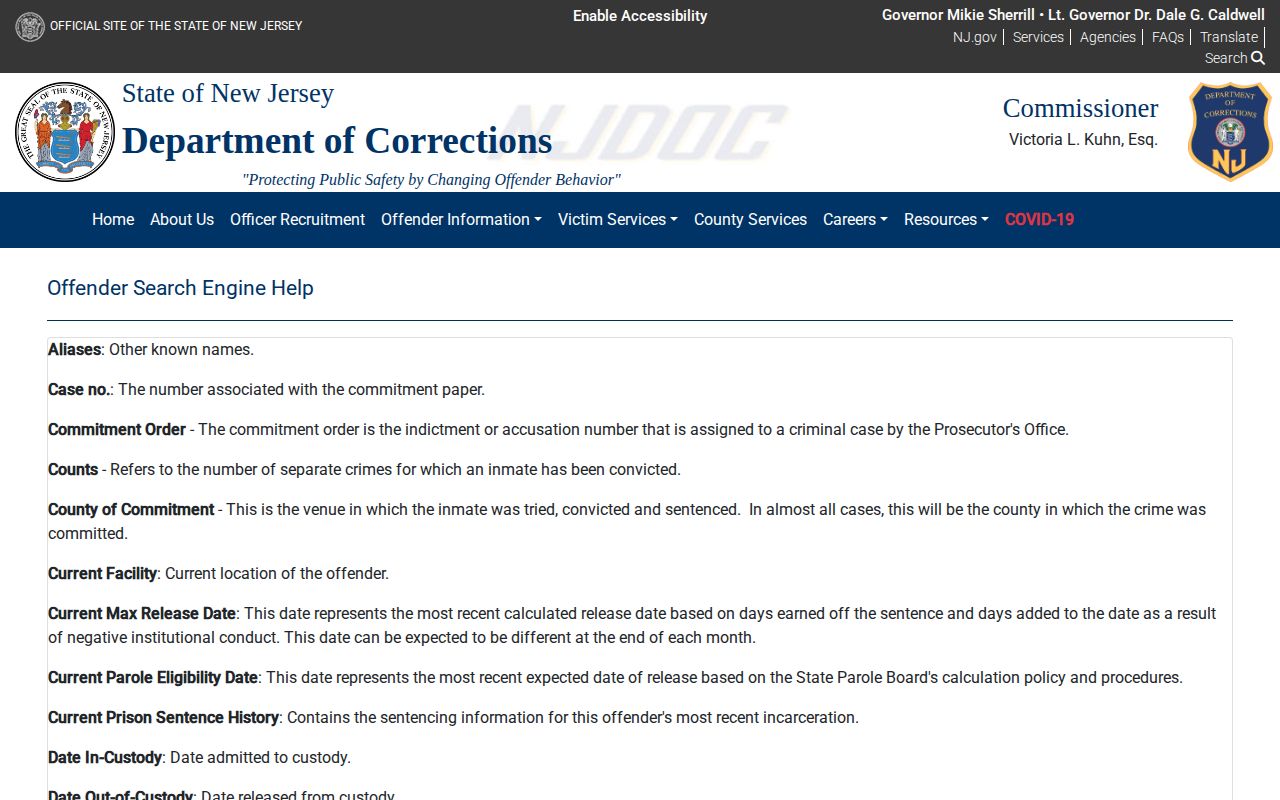
The image supports a field-by-field reading. It does not support homemade arithmetic or a promise that a listed date will remain unchanged.
| NJDOC field | What it establishes | Main caution |
|---|---|---|
| Date In-Custody | Admission date for an incarceration period | Not a county booking date in every case |
| Date Out-of-Custody | Completed release from custody | Read supervision context separately |
| Current Max Release Date | Latest calculated maximum-release date | Can change at month end |
| Current Parole Eligibility Date | Latest expected date for parole eligibility | Not a grant or completed release |
| Mandatory Minimum Term | Time during which release is barred, subject to applicable credits | Exact law and sentence control |
| County of Commitment | Venue of trial, conviction, and sentence | Not current physical location |
Sentence history can also show commitment or case numbers, offenses, maximum terms, and mandatory minimums. Compare them with the Judiciary judgment. If the official sentence calculation itself is needed, contact NJDOC rather than presenting a personal estimate as an agency date. Save the date on which the portal was checked because a later monthly calculation may differ.
Morris County Release Date Credits
New Jersey sentence credits come from several sources. N.J.S.A. 30:4-140 provides progressive commutation credits for continuous orderly behavior against minimum and maximum terms, with statutory tables and possible forfeiture for flagrant misconduct. State work and assignment credits relate to N.J.S.A. 30:4-92. County credits use separate provisions, including N.J.S.A. 30:8-28.1 et seq. Court-awarded credits can also affect the calculation.
The parole-eligibility statute, N.J.S.A. 30:4-123.51, generally places primary eligibility after a mandatory minimum when one exists. Without one, the general starting point is one-third of the term less applicable credits, subject to statutory floors and detailed exceptions. The research identifies a specific sixty-day or statutory-floor provision for a county inmate and a nine-month floor for a state specific-term inmate. These details are why a simple sentence-minus-days formula is unsafe.
Credits can be earned, forfeited, restored, or corrected. Multiple commitments may run concurrently, meaning at the same time, or consecutively, meaning one after another. Jail credit and gap-time credit can come from a court order. The displayed Current Max Release Date already reflects the agency’s present calculation. Subtracting a credit table again may count the same time twice.
Note: Link the person’s exact sentence and credit orders to the agency calculation before treating any Morris County date as stable.
Morris County NERA Release Dates
The No Early Release Act, N.J.S.A. 2C:43-7.2, is often shortened to NERA. It applies to enumerated first- and second-degree crimes. The sentencing court fixes a minimum equal to 85 percent of the sentence imposed, during which the person is not eligible for parole. For that statutory calculation, a life sentence is deemed to be 75 years. NERA also provides a parole-supervision term of five years for a first-degree sentence and three years for a second-degree sentence, subject to the statute.
The 85 percent rule does not apply to every New Jersey sentence. Offense, degree, sentence, offense date, and other law control. A different mandatory minimum may be longer. Court credits, concurrent or consecutive terms, sentence corrections, and disciplinary changes can alter the displayed fields. The right method is to read the judgment and NJDOC calculation, not to assume that every Morris County state prisoner serves the same fraction.
Parole eligibility also differs from parole release. A person can reach the Current Parole Eligibility Date and receive a denial. The Board may then set a Future Eligibility Term, which establishes the next consideration period. A grant sets a future release date, but a later rescission proceeding can review that grant before the person leaves.
Why Morris Release Dates Recalculate
NJDOC warns that Current Max Release Date can differ at the end of each month. Days earned and days added for negative institutional conduct change the calculation. This is the distinctive New Jersey release-date quirk: the date is a live agency result, not a fixed subtraction made once at sentencing. NERA’s 85 percent minimum, when it applies, adds another legal limit, but it is not a blanket rule.
Several events can move or change the practical release date. A detainer is a request or legal hold from another authority. It may cause a transfer rather than community release. A court can amend a judgment or award credit. The parole board can grant, deny, or rescind parole. A disciplinary event can affect credit. A data correction can change the agency record without any new court sentence.
Check the displayed date again near month end and before making any plan that depends on a prison exit. Save the field label and access date, since a later calculation may differ without showing that the earlier screen was false. For a Morris County commitment, compare the updated NJDOC value with the judgment and any State Parole Board notice. If the date passes but no Date Out-of-Custody appears, contact the responsible agency. A projected date cannot rule out a new hold, a receiving authority, or processing that remains incomplete.
| Factor | Possible effect | Best record to check |
|---|---|---|
| Earned or restored credit | May move the calculated maximum earlier | NJDOC sentence calculation |
| Forfeited credit | May move the calculated maximum later | NJDOC disciplinary and sentence record |
| Mandatory minimum or NERA | Bars earlier parole during the controlling term | Judgment and governing statute |
| Parole grant or denial | Sets a release date or a future eligibility term | NJSPB Notice of Decision |
| Detainer or receiving authority | Can turn jail exit into a transfer | Release record and receiving-agency record |
| Court correction or credits | Can revise the term calculation | Amended judgment or court order |
Morris County Release Date Stages
A state sentence moves through several distinct stages: sentence calculation, parole eligibility, hearing or administrative review, grant or denial, scheduled release, actual Date Out-of-Custody, supervision when required, and completion or discharge. Each stage can produce its own date. “Eligible,” “granted,” “scheduled,” “released,” and “discharged” should never be used as synonyms.
NJSPB’s Earn Your Way Out administrative parole process took effect in 2021 under N.J.S.A. 30:4-123.55b et seq. Official guidance lists exclusions that include qualifying registry offenses, NERA sentences, Graves Act sentences, and specified SVPA-related categories. It also includes disciplinary and program criteria. Eligibility for that process is not retrospective proof of release. The completed Date Out-of-Custody remains the state record to confirm.
- Eligibility date
- The date a person may be considered under the applicable parole rules.
- Scheduled date
- A future date set after a present calculation or decision.
- Actual date
- The completed county date and time out or NJDOC Date Out-of-Custody.
- Detainer
- A hold or request from another agency that can lead to continued custody or transfer.
- Discharge
- Completion of the controlling custody or supervision term.
Confirm Morris County Actual Release
For a Morris County jail case, a court order explains the legal authority but does not prove that release processing finished. Ask Facility Records for the date and time out and, when public, whether the destination was the community or another authority. A transfer to NJDOC, ICE, another county, or federal custody ends the Morris jail episode without freeing the person.
For a state prisoner, look for a completed Date Out-of-Custody in incarceration history. Then check parole or mandatory-supervision context. For a pending event, New Jersey VINE can send a qualifying release or transfer notice. The Morris County VINE inmate check explains how to register before release. VINE can lag, and a transfer event is not community release, so confirm with the holding agency.
NJDOC removes most completed custodial records from web search one year after the maximum sentence or mandatory parole supervision term ends. CSL and PSL records remain because those terms lack a completion date. An older no-result therefore does not prove the state sentence never existed. Use the court case, NJDOC records process, and the Morris County released inmate search path when the public locator no longer returns the person.