
NJSPB Morris Release Role
The New Jersey State Parole Board administers parole and certain statutory supervision terms after release. It does not operate the prison from which a person leaves. NJDOC supplies the incarceration history and Date Out-of-Custody. The Board supplies the parole decision, supervision framework, and enforcement or discharge record within the bounds of public access. A person can therefore be out of an NJDOC institution while still under the Board’s legal authority.
Parole differs from probation. Parole follows a custodial sentence and is administered by NJSPB. Probation comes from a Superior or municipal court order and is administered through the Judiciary’s Probation Division. Pretrial monitoring is yet another status. The judgment, NJDOC history, and Board record establish which label applies. A Morris County jail exit alone cannot establish parole.
| Status | Administering authority | Best record |
|---|---|---|
| Parole | New Jersey State Parole Board | NJDOC history plus Board record |
| Probation | New Jersey Judiciary | Judgment or court order |
| Pretrial monitoring | Judiciary Pretrial Services | Release order and case record |
| Sentence discharge | Custodial or supervising agency | Official discharge entry |
Verify Morris Parole Release
No comprehensive public Morris County parolee roster was found. Verification requires an identity-first chain. Start with the NJDOC Offender Search, preferably using the SBI number. Review Incarceration History for Date Out-of-Custody and compare County of Commitment, offense, sentence, and identifiers. Then use the Board’s official contact route for the public status information it can provide.
- Match the person in NJDOC by SBI number or a carefully checked name and alias search.
- Record the Date Out-of-Custody and parole-related dates without treating eligibility as release.
- Read the Morris court judgment for the sentence and any supervision term.
- Contact NJSPB public information with the SBI number, release date, and a narrow status question.
- Use New Jersey VINE for a qualifying custody alert, not as a lasting parole roster.
- For probation rather than parole, contact the Morris/Sussex Vicinage instead of NJSPB.
The Morris post-release supervision resource gives the wider parole and probation comparison. For a Board-specific inquiry, keep the question tied to the record requested, such as whether an existing public entry shows active parole or discharge.
NJSPB Morris Release Contacts
The New Jersey State Parole Board contact page is the current official routing source. Research identified a public-information email for lawful status questions. District Office #1 at 114 Prospect Street in Passaic was described in an older official report as serving Morris, but its older phone should be verified before reliance. The statewide contact page should control when office assignments change.
New Jersey State Parole Board
Public information:
SPB-Public-Info-Office@spb.nj.gov
Official routing:
Use the current NJSPB contact page
Provide the full name, SBI number, and relevant release date where known. Public staff may limit person-specific details. A narrow record question is more useful than a request for a broad assessment. The Board does not publish a searchable person-level decisions database, and aggregate annual reports cannot confirm one person’s release.
Note: A district office supervises cases; it is not a detention facility and does not create the prison’s physical release timestamp.
NJSPB Hearing Release Outcomes
The Board’s hearings information describes initial, panel, rescission, and revocation proceedings. At an initial or panel stage, members assess release under the governing standard. A grant can still face rescission if new information or conduct arises before the planned exit. A denial can produce a future eligibility term, which means another review point rather than an actual release date.
Revocation deals with alleged violations after a parole release. A serious or persistent violation can lead to arrest and temporary detention, sometimes first at a county jail. NJDOC may then transport the person to the Central Reception and Assignment Facility while proceedings continue. The panel can revoke parole and establish a future eligibility term or continue parole with conditions. Leaving the Morris jail during that process can be a state transfer rather than a return to the community.
The official hearing-process source is represented in the captured NJSPB hearing page.
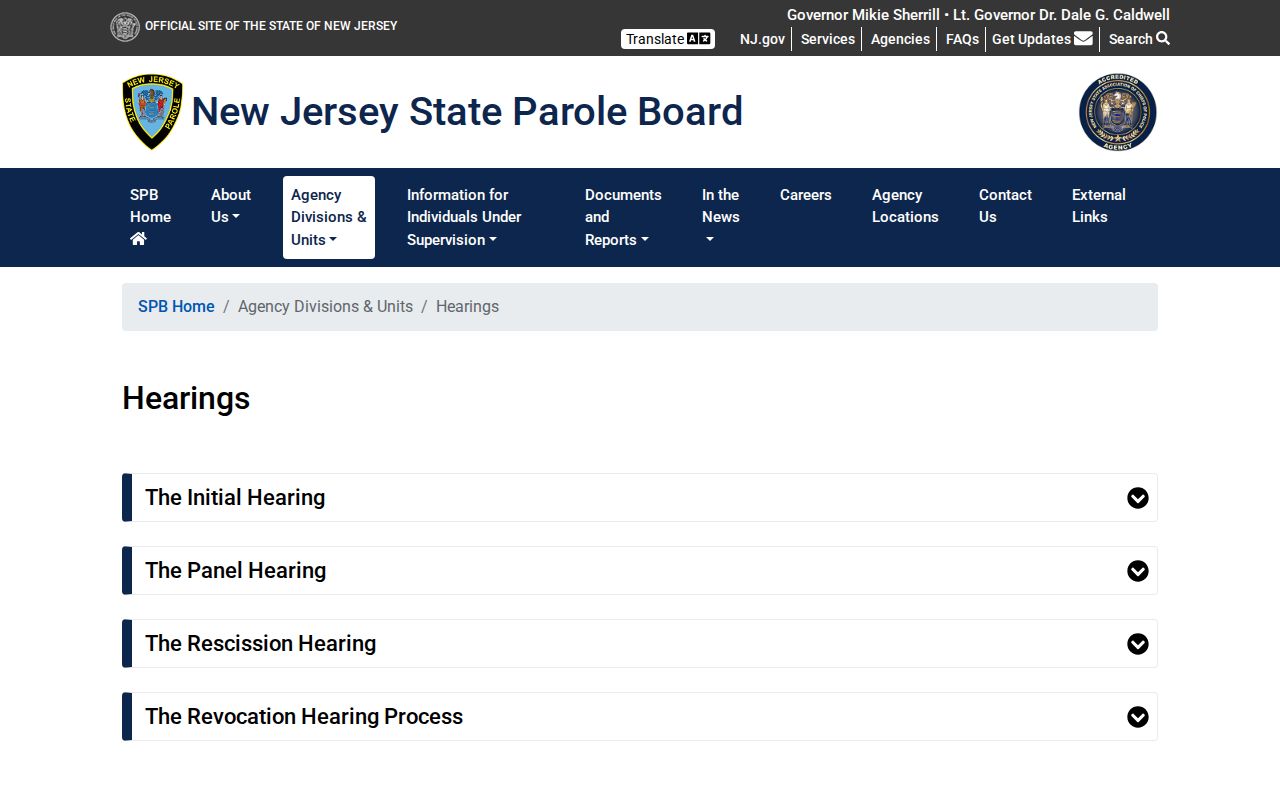
The image supports the hearing framework, not a claim that individual decisions are searchable there.
NJSPB Release Versus Discharge
Release and discharge mark different points. Release from prison is the physical end of that confinement. Parole supervision can begin immediately and continue for the applicable term. Discharge is the formal end of the supervision authority. The NJDOC Date Out-of-Custody may prove the prison exit while a Board record is still needed to determine whether the person remains on parole.
- Parole release
- Exit from prison under State Parole Board conditions.
- Eligibility date
- A date when parole consideration may occur, not a promise of release.
- Revocation
- A Board process that can return a person to custody after a violation finding.
- Discharge
- The formal completion of the applicable supervision term.
- Absconder
- A person alleged to have left supervision without authorization; verify the current status with the issuing agency.
A sentence may also carry Parole Supervision for Life or Community Supervision for Life. Those records remain visible in NJDOC because the terms do not have an ordinary completion date. Read the exact judgment and agency entry rather than inferring status from the age of the conviction.
NJSPB Morris Warrant Checks
No official public Morris County list of parole or probation absconders was found. The Sheriff’s warrants function, courts, and NJSPB enforcement units handle different warrants. A stale wanted notice or a missed web update is not reliable proof of an active warrant. Verify the issuing agency and date before stating a current status.
The NJSPB Fugitive Apprehension Unit accepts absconder information or tips at 1-800-668-7025 and SPB-Fugitive-Tip-Submit@spb.nj.gov. That channel is not the normal way to certify routine parole status. For a general public-record question, use the Board public-information route. For immediate safety or an active law-enforcement matter, use the proper emergency or issuing-agency channel.
NJSPB Morris Release Conditions
Parole conditions define conduct during supervision, but a public page should describe them only at a high level. The controlling terms are the person’s actual certificate, Board order, and later modifications. Common concepts can include reporting, approved residence or movement, treatment, and compliance with law, yet the presence or wording of any condition must come from the case record. Do not infer a violation from rumor or a delayed public update.
When an alleged violation occurs, arrest and detention do not themselves prove revocation. The Board hearing process determines whether parole continues, changes, or is revoked. A future eligibility term after revocation is another review point, not a guaranteed release date. If Morris County jail temporarily holds the person, its release record should identify whether the next event was a community return or NJDOC transfer.
Supervision ends through an official discharge or other lawful termination, not merely through the passage of an estimated date. Ask the Board for the existing releasable status or discharge entry as of a specified date. This protects against confusing an old parole release with current supervision.
NJSPB Morris Record Requests
Request an existing Board record with identifiers and a defined scope. Useful details include the full name, aliases, SBI number, Morris commitment or docket number, approximate parole-release date, and the precise record sought. Examples include a releasable decision, supervision-status entry, discharge record, or record of a specified hearing. The agency may redact protected information or decline person-specific details outside public scope.
The New Jersey Open Public Records Act applies to existing government records subject to exclusions and other law. It does not require the Board to create a new explanation, analyze whether someone complied with conditions, or predict future conduct. Ask for electronic delivery and whether fees will apply before special work is performed. If a denial occurs, the response should identify its legal basis and available review route.
Board annual reports offer aggregate information about hearings and supervision, but they are not a substitute for an individual record. No public calendar of named upcoming hearings or searchable person-level decision archive was found. The absence of a name from a report page therefore proves nothing about a Morris parole case. Use the person’s SBI number, NJDOC custody history, and the Board’s records channel instead of searching aggregate tables for a match.
When a status is old, also account for discharge. A former parolee may have completed the supervision term even though an older court or NJDOC entry still documents the sentence. Ask whether the existing Board record shows active supervision, discharge, revocation, or another maintained status as of a stated date. That focused wording avoids treating historical parole as a claim about the present.
Use each agency for its own event. NJDOC records the state incarceration history. NJSPB records parole proceedings and supervision. The Judiciary records the sentence and probation orders. Morris County records a local jail stay. VINE supplies alerts. Combining those records carefully avoids treating release from one building as the end of every legal status.