
NJDOC Morris Release Paths
The New Jersey Department of Corrections is a statewide prison system, not a Morris County jail. No general-population NJDOC prison was identified within Morris County, but a person sentenced in a Morris case may be assigned anywhere in the state system. The NJDOC record’s County of Commitment field identifies the venue in which the person was tried, convicted, and sentenced. It does not say that the person stayed at the Morris County Correctional Facility.
A state prisoner may leave an institution on parole, move to a Residential Community Release Program, or reach a maximum release from custody. A residential community placement remains part of the corrections continuum and is not necessarily an unconditional discharge. Parole ends prison confinement but begins or continues legal supervision through the New Jersey State Parole Board. A max-out date can end the custodial sentence, subject to any separate supervision term or another authority’s hold.
| NJDOC event | What it means | Best confirming field |
|---|---|---|
| Institution transfer | Movement within NJDOC | Current facility and custody history |
| Community placement | Structured placement under corrections authority | Program or location plus current status |
| Parole release | Leaves prison under Board supervision | Date Out-of-Custody plus parole context |
| Maximum release | Custodial maximum reached | Historical Date Out-of-Custody |
Search NJDOC Morris Discharges
The NJDOC Offender Search is the main public route for a Morris County state commitment. Users must accept the search conditions before reaching the form. The SBI number, a state identification number assigned to an offender, is the strongest key. If it is unknown, use the legal name and documented aliases, then compare age, descriptors, sentence-as name, offenses, and County of Commitment before choosing a record.
- Accept the official NJDOC search notice and enter the SBI number when available.
- For a name search, try the legal name and known aliases without assuming that the first match is correct.
- Open the matching record and compare County of Commitment, offense, sentence date, and identifiers.
- Review Incarceration History for a completed period with a Date Out-of-Custody.
- Read Current Prison Sentence History for parole eligibility, maximum release, mandatory-minimum, and case details.
- When the form is unclear, compare the court disposition and contact NJDOC or the Parole Board for the record each agency maintains.
The official search form is shown in the captured NJDOC offender-search source.
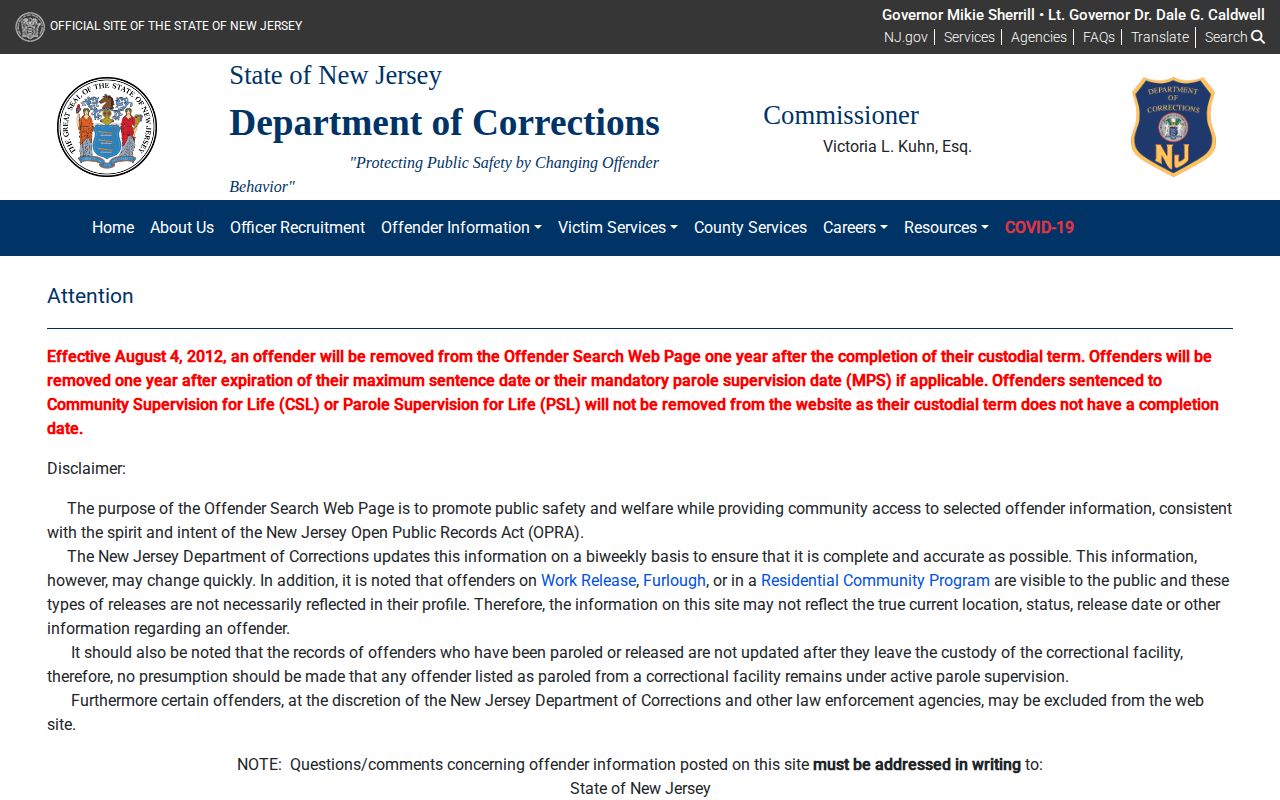
The form supports state-system searching. It does not cover every short Morris County jail stay.
NJDOC Morris Release Dates
The NJDOC field definitions separate historical release from a forecast. Date In-Custody is the admission date. Date Out-of-Custody is the date released from custody for that incarceration period. A completed period with a Date Out-of-Custody is stronger evidence of an actual state-system exit than a blank facility field or a projected sentence date.
Current Max Release Date is the most recent calculated release date after earned days and days added for negative institutional conduct. NJDOC warns that the calculation can change at each month end. Current Parole Eligibility Date is the most recent expected eligibility date under State Parole Board policy. Eligibility permits consideration; it does not guarantee that parole will be granted. A mandatory minimum can control when parole becomes possible.
- Date Out-of-Custody
- A historical NJDOC date showing that a custody period ended.
- Current Max Release Date
- A changing sentence calculation, not proof that release has occurred.
- Current Parole Eligibility Date
- The point when parole consideration may become available, not a promised exit.
- County of Commitment
- The county tied to trial, conviction, and sentence, not the person’s prison location.
Note: A future date can change, and a past prison exit may still lead to parole supervision or another agency’s custody.
NJDOC Record Retention Limits
Most completed NJDOC custodial records do not remain in the public web search forever. The research found that NJDOC removes most completed records one year after the maximum or mandatory parole supervision term ends. Community Supervision for Life and Parole Supervision for Life entries remain because those terms have no completion date. A no-result screen can therefore reflect elapsed web-retention time rather than proof that no state custody occurred.
This online rule differs from county detention retention. New Jersey’s county schedule retains certain electronic daily discharge report series for at least three years, but those are Morris County records rather than NJDOC’s public offender-search display. Online visibility, agency retention, and public disclosure are three separate questions. When a historical state record no longer appears, submit a focused request to NJDOC and use the Morris court judgment to identify the case and commitment.
NJDOC Parole Release Context
Release from an NJDOC institution does not always mean the sentence or all legal supervision ended. Parole places the person under New Jersey State Parole Board jurisdiction and conditions. The NJDOC history can establish the out-of-custody date, while the Board is the better source for the status of supervision. New Jersey VINE may supply a custody-event alert, but it is not a public roster of all parolees.
A parole eligibility date should never be reported as an actual release date. The Board may grant parole, deny it and set a future eligibility term, rescind an earlier grant before release, or later address an alleged violation. A person arrested on a serious or persistent parole violation may be held in a county jail and then moved to NJDOC’s Central Reception and Assignment Facility for proceedings. That movement is a transfer into custody rather than another release.
The Morris County post-release supervision page separates parole, probation, pretrial monitoring, and discharge. Use the court judgment for probation, NJDOC and NJSPB for parole, and the custodial agency for the physical release event.
Request NJDOC Morris Records
The public locator is not a certified record and is not designed to supply every former inmate file. For an official historical record, request the existing NJDOC material with enough detail to locate it. Include the full name, aliases, date and place of birth where known, SBI number, Morris County commitment or case number, approximate admission and exit dates, and the exact fields or documents needed. A narrow request reduces name confusion and avoids asking the custodian to create a new analysis.
Ask for incarceration history, the maintained admission and Date Out-of-Custody entries, sentence history, release or transfer record, and the code legend needed to interpret a status. State whether an electronic or certified copy is needed. NJDOC may redact or withhold protected material under applicable law. The New Jersey Open Public Records Act covers existing government records subject to exemptions; it does not compel an agency to answer why release occurred or to calculate a new sentence projection.
Pair the agency record with the Morris court judgment when the legal outcome matters. The court can show the conviction, sentence, credits, dismissal, or later order. NJDOC remains the source for the physical state-custody history and sentence calculation. If an expungement or sealing order limits public access, respect that limit rather than attempting to reconstruct suppressed material.
NJDOC Morris Release Planning
NJDOC’s Office of Transitional Services and Fair Release and Reentry Act resources add context before discharge. Release planning can begin while the person remains in state custody and may coordinate records or services for the transition. Participation in planning is not proof that the final release occurred on a projected date. The historical Date Out-of-Custody and the agency’s release record remain the confirming fields.
For a Morris commitment, keep state planning separate from the county’s jail reentry program. The programs are run by different agencies and serve different custody stages. A person transferring from Morris to NJDOC has not yet reached the state release stage. A person leaving an NJDOC institution may later report to the State Parole Board or another supervision authority. Follow the actual sequence and source every step to the agency record.
NJDOC Versus Morris Custody
A negative NJDOC result is normal for many people who spent time only at Morris County Correctional Facility. The county jail holds pretrial detainees and people serving county terms, while NJDOC holds people committed to the state system. A person can leave Morris for community release without ever entering NJDOC. Conversely, a person can disappear from the Morris jail because a state sentence moved the person to NJDOC reception.
The state search can also show a residential community placement or other current location that a casual reader may mistake for full discharge. Read the agency status, incarceration period, sentence screen, and parole fields as a set. When County of Commitment says Morris, use the Morris judgment to verify the sentence but do not call the statewide placement a Morris facility. Geographic location and legal commitment are separate facts.
| Custody episode | Correct release source | Key evidence |
|---|---|---|
| Morris-only detention | Morris Records, Sheriff OPRA, court, VINE | County date/time out and disposition |
| State sentence | NJDOC, NJSPB, court | Date Out-of-Custody plus supervision context |
| Federal sentence | BOP and federal docket | Past release date and RELEASED status |
| ICE custody | ICE ODLS and ERO | Current or recent ICE event within locator scope |
Choose the system from the legal and physical custody facts. Do not use NJDOC as a catch-all released-inmate archive for Morris County.