
Morris Facility Release Paths
The Morris County Correctional Facility is the county jail at 43 John Street in Morristown. The Morris County Sheriff’s Office operates it through the Bureau of Corrections. A pretrial detainee may leave after a court orders release with conditions, after bail where applicable, or after a charge is dismissed. A sentenced person may leave after time served or completion of a county term. Those outcomes can return someone to the community, but the date and legal reason must be read from the release record and court order.
Other exits are transfers. A state-prison sentence normally sends the person into New Jersey Department of Corrections custody. A federal writ can place a person in U.S. Marshals custody, while an immigration detainer can lead to ICE custody. Another county may also control the case even when Morris supplied the bed. Disappearance from Morris custody proves only that the local custody episode ended. It does not establish freedom, destination, or the end of supervision.
Confirm Morris Facility Release
Morris County does not publish a person-name jail roster, historical booking archive, or labeled recent-release list on its official web pages. Start with the agency that held the person. Facility Records can confirm routing and may explain whether a public record exists, although staff can limit what is disclosed by phone. The court case then supplies the order or disposition that authorized the exit. New Jersey VINE can report a custody event, but it is an alert system rather than a certified release record.
- Call Facility Records at 973-631-5174 with the full name, date of birth if known, booking number, and approximate custody dates.
- Ask whether the existing public record shows a date and time out, a release or disposition code, and a community destination or transfer.
- Search New Jersey VINE by exact name or offender identifier and compare the listed agency and descriptors.
- Check the New Jersey Judiciary case for a release order, dismissal, judgment, sentence, or transfer-related event.
- If the case shows state commitment, switch to NJDOC Offender Search. Use BOP, ICE, or the federal docket only when the facts support those custody types.
A VINE “released” event is useful, but confirm it with Morris Records when the precise time or destination matters. Likewise, a court order can precede the physical steps needed to leave the building. The county record is the best source for the actual physical exit. The broader Morris County released-inmate search explains how these systems fit together.
Morris Facility Release Records
The Sheriff’s Bureau of Corrections page says Support Services maintains inmate records. That makes the published Records line the correct first contact. General administrative numbers serve other functions and should not replace Records for a booking or release question.
Morris County Correctional Facility Records
43 John Street
Morristown, NJ 07960
Records: 973-631-5174
The official source shows how record responsibility is divided. The Bureau of Corrections record information appears in the captured view below.
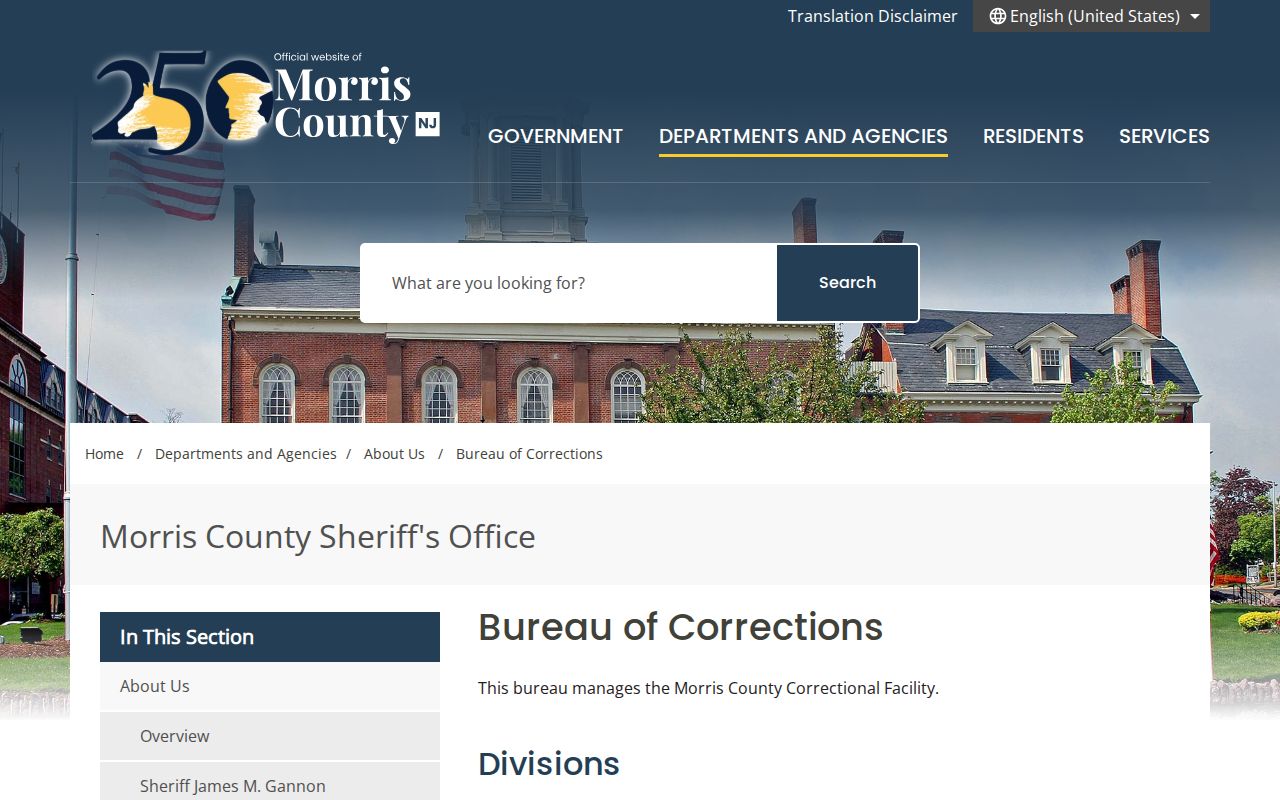
The image supports the use of Support Services and Records, not a claim that the county offers an online released-person search.
Note: The jailrecords@co.morris.nj.us address is published for attorney and court videoconferencing, not as a general public records inbox.
Request Morris Facility Discharge Records
When a phone check is not enough, use the Sheriff-specific OPRA channel. The county’s general records page directs Sheriff material to this separate custodian. Describe an existing record and one custody episode. Useful identifiers include the full name and alias, date of birth if known, booking or case number, and an approximate admission and release range.
Request the booking or intake record, release or discharge entry, date and time out, maintained release or disposition code, and a transfer record naming the receiving agency if one exists. Ask for the code legend needed to read the disposition. The custodian may disclose, redact, deny under a stated legal basis, seek clarification, or report that no identifiable responsive record exists. OPRA does not require staff to investigate the case or create a new narrative.
- Release record
- The existing county entry that documents when and how the Morris custody episode ended.
- Disposition
- The maintained legal or operational outcome, such as community release, sentence completion, or transfer.
- Transfer
- A move into another agency’s custody, which is not the same as release to the community.
OPRA fees depend on the record and work required. No fixed Sheriff price for a release record is published in the cited sources, so ask for an estimate before agreeing to a special charge. Court records follow Judiciary Rule 1:38 rather than county OPRA.
Morris Adult Release Property
The adult facility’s General Information page publishes in-custody property rules, not a gate-release property procedure. An incarcerated person may send accumulated property out at personal expense or arrange pickup by friends or relatives on a scheduled visiting day. The page also publishes account-related lobby hours. None of those facts establishes a release door, family waiting area, weekend release rule, ride program, or standard property handoff at discharge.
This distinction prevents a common mistake. The Morris juvenile handbook has detailed discharge rules involving an approved adult, signed property receipt, a court order, and a gated rear exit. Those rules apply only to the juvenile facility and cannot be used for an adult leaving the Morris County Correctional Facility. For an adult property issue, contact the jail and ask for the current procedure tied to that person’s custody episode.
Note: Published money-order and lobby-kiosk hours concern in-custody accounts and do not establish when adult releases are processed.
Morris ICE Release Handoffs
An immigration detainer can make the end of Morris custody look like release even when ICE immediately assumes custody. Ask the county record keeper whether the destination or transfer field names ICE. If it does, the Morris date and time out close only the county-jail episode. The later immigration detention and any later release are federal events that must be checked through the ICE Online Detainee Locator System or the appropriate Enforcement and Removal Operations contact.
ICE states that its locator includes eligible people currently detained and people released from ICE custody within the prior 60 days. That limited window can help after a documented Morris handoff. A no-result remains inconclusive because the locator has age, identity, safety, data, and short-custody limits. Preserve the county transfer entry, search with a nine-digit A-number and country of birth when available, and do not turn absence into a claim of community release or removal.
Morris Facility Record Context
The direct-supervision facility opened in May 2000. The county describes a six-story building with systems including CCIS, CJIS, and RMCS. Those internal systems help staff operate the jail and maintain data, but the county does not expose them as a public historical roster. A sophisticated internal record system and an online public search are different things.
New Jersey’s county detention retention schedule gives additional context. Electronic daily population, commitment, and discharge report series have a three-year minimum. A Records Section copy of the county detention admission form has a two-year minimum after discharge or sentence completion. These schedules are disposal rules, not promises of web display or automatic disclosure. A custodian may still apply exemptions, redactions, holds, or a different applicable series.
The schedule also lists a Photo Card File or Index with a ten-year minimum after disposition or release, along with some account, discipline, visitation, and program records that may run for three years after release. These periods help identify a likely record series after public web visibility ends. They do not mean that every item is open, that Morris uses each series in the same way, or that a photo proves the outcome of a case. Ask the custodian which series holds the requested field and what redaction rules apply.
That is why a focused request works better than a broad question. Name the person and episode, identify the existing discharge or transfer fields sought, and ask for electronic delivery. If the county record indicates NJDOC, federal, ICE, or another county custody, continue with that authority rather than treating the Morris exit as a final release.